
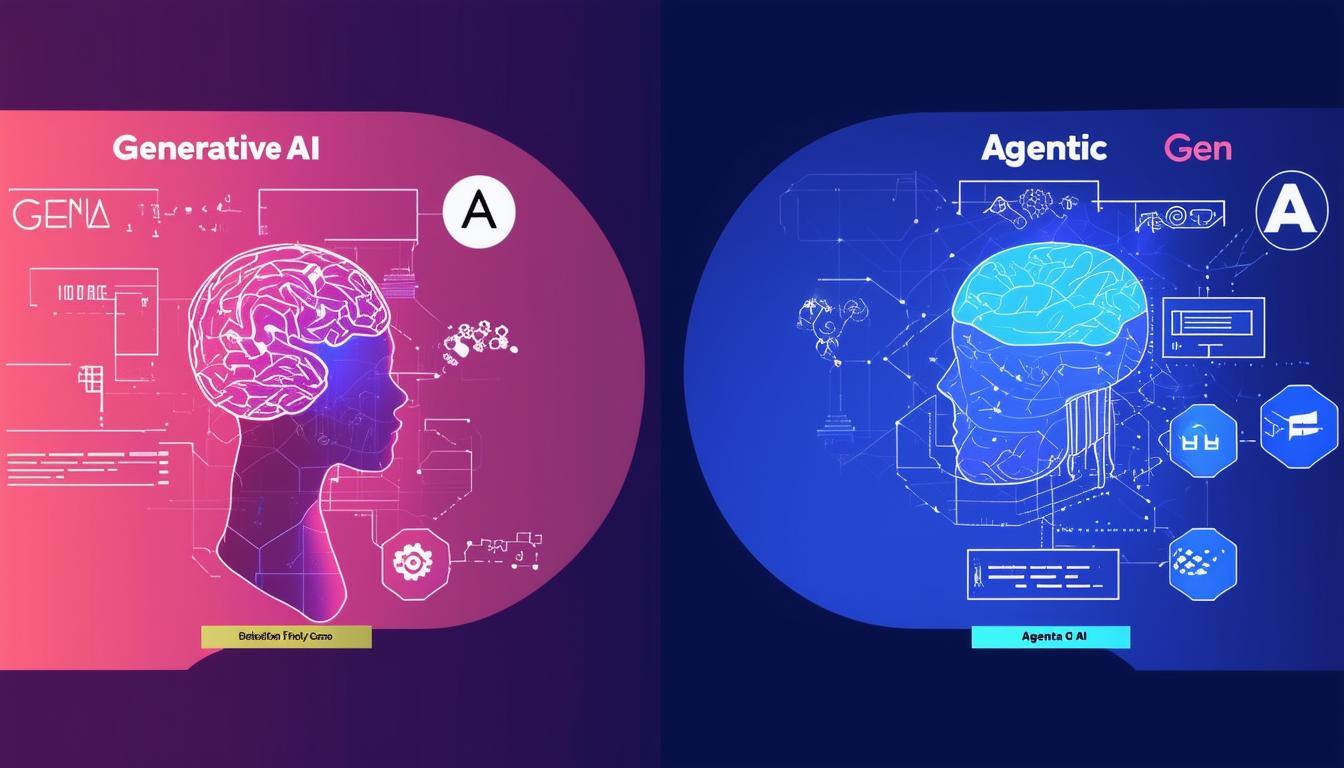
Agentic AI vs Generative AI. This isn’t just a technical term; it’s a revolution in how AI works. Think of it like the difference between an artist and a project manager. Ask an AI to plan your dream getaway. A generative AI will whip up a stunning itinerary: “Watch the sunrise over Santorini! Hike Machu Picchu at dusk!” It’s poetic, inspiring… and completely hands-off.
Now imagine an agentic AI: It hunts down flight deals while you sleep, compares hotel reviews, books your rental car, snags that hard-to-get dinner reservation, and texts your partner to confirm dates. It doesn’t just describe your trip, it builds it.
That leap? From creating content to taking real-world action? That’s the evolution that’s happening right now in AI.
As these tools reshape everything from how we work to how we relax, understanding the generative AI vs agentic AI split isn’t just for techies.
It’s for anyone who wants to use AI wisely, not just as a novelty, but as a genuine partner.
Meet the Creative Genius: Generative AI
Generative AI is your digital Picasso or composer. Feed it a prompt about writing the poem or designing the logo, and it spins up something original, text, images, music, even code.
Picture it like the world’s smartest autocomplete. It’s devoured mountains of data, every Wikipedia entry, every classic novel, every public code repository.
The secret ingredient? It’s a prediction powerhouse. Trained on oceans of data, it calculates probabilities: “After the word ‘starry,’ what’s statistically likely? ‘Night’? ‘Sky’? ‘Eyed’?” Or: “If this pixel is deep blue, the pixels around it should probably be lighter blues or purples.” Tech folks call it “autocomplete on steroids” – and honestly, that nails it.
Why Generative AI Feels Like a Brilliant (But Lazy) Assistant
Think of generative AI as that incredibly talented friend who only works when you give it explicit instructions. They’re amazing at their craft, whip up a poem, design a logo, draft an email, but they won’t lift a finger until you ask.
They’re reactive, not proactive.
Here’s what that means in practice:
Prompt Prisoner:
It needs your specific request. “Write me a vacation itinerary for Bali,” gets you a beautiful document. But if flights to Bali are suddenly $5,000? It won’t say, “Hey, prices spiked, want me to check Thailand instead?” It waits silently for your following command.
No Memory Lane:
It largely forgets your last conversation unless specifically designed to remember (and even then, it’s limited). Ask it to optimize the code it just wrote? You have to explain the whole thing again.
Goal? What Goal? It responds brilliantly to your prompt, but it doesn’t grasp your bigger objective. You asked for a “fun weekend itinerary,” but it doesn’t know you hate crowds or love hiking. It guesses based on averages.
One-and-Done:
It completes the single task you gave it. Finished that Bali itinerary? Its job is done. It won’t proactively check hotel availability, warn you about monsoon season, or remind you to renew your passport.
In short: You drive. Generative AI is the passenger who gives great directions only when you ask. It’s a genius trapped in a soundproof booth.
Meet the Go-Getter: Agentic AI Steps Up
What is agentic AI vs generative AI when it comes to next automation?
Now, imagine an AI that’s less like an order-taking assistant and more like a trusted colleague you hand a project to. You give it a goal, not just a task.
Agentic AI is the difference between:
Telling someone, “Draft a list of potential hotels” (Generative)
Saying, “Plan and book my family’s summer vacation within budget, ensuring kid-friendly activities” (Agentic)
Agentic AI doesn’t just spit out content; it takes initiative and gets stuff done. It’s built to understand a complex objective and figure out how to achieve it, step-by-step, with minimal babysitting.
How Agentic AI “Thinks” (Like a Human Problem-Solver):
Seeing & Understanding (Perceiving):
It scans information, your budget, dates, past travel preferences, real-time flight prices, hotel reviews, and identifies what matters. “Ah, they need pet-friendly lodges and direct flights under 5 hours.”
Making a Plan (Reasoning):
It breaks the big goal into steps: “Okay, step 1: Find flights. Step 2: Filter pet-friendly hotels near the beach. Step 3: Compare total costs. Step 4: Book the best combo. Step 5: Email the itinerary.” It weighs options and makes decisions.
Doing the Work (Acting):
This is the magic. It uses tools. It searches flight APIs, accesses booking systems, compares prices across sites, reserves spots on tours, and sends confirmations, all by itself. It’s not just talking about a vacation; it’s building it.
Learning & Adapting (Learning):
If something goes wrong (a hotel is full), it doesn’t just crash. It learns: “Next time, check availability before finalizing flights.” It gets better with experience.
The Key Difference: Agentic AI vs Generative AI?
You don’t micromanage Agentic AI. You set the destination, provide the guardrails (budget, constraints), and let it navigate. It’s the tireless project manager, the relentless researcher, the executor.
It is constantly working towards your goal, not just waiting for the next command. It has a to-do list, not just a prompt box. Think of it like handing keys to a very competent, digital colleague.
How Agentic AI Gets Stuff Done: Your Digital Colleague’s Toolbox
Imagine building a dream team inside your computer. That’s essentially what powers agentic AI. Here’s what’s happening under the hood in plain terms:
- The “Brain” (Models):
This is the big-picture thinker. You give it a goal like “Improve customer satisfaction scores,” and it doesn’t just stare blankly.
It breaks it down: “Okay, step 1: Find out why customers are unhappy. Step 2: Brainstorm fixes. Step 3: Put the best ideas into action. Step 4: Check if it worked.” It’s the strategist.
- The “Hands” (Tools):
The brain is smart, but it can’t do anything alone. This is where “tools” come in – like giving your AI access to real-world apps and systems. Think:
- Pulling data from your customer feedback surveys
- Searching your helpdesk software for common complaints
- Sending emails to customers for follow-up
- Updating your CRM with notes
- The “Conductor” (Orchestration Layer):
This is the project manager. It makes sure the Brain and the Hands work together seamlessly.
Brain says we need survey data? Hands, go get it from SurveyTool. Data shows slow response times are the issue? Brain, figure out a fix.
Brain suggests a new FAQ page? Hands, draft it using the writing AI and notify the team.
It’s the glue, constantly coordinating the steps using specialized AI “workflow managers” (like LangChain or CrewAI).
Think of it like this:
- Generative AI is a powerful tool (amazing for one specific job).
- Agentic AI is your newest hire – a digital colleague you hand a complex project to. You don’t micromanage each step; you trust them to figure it out and report back.
Example: You tell Agentic AI: “Boost our customer satisfaction scores this quarter.”
It might:
- Analyze last month’s support tickets and survey results (Using Tools to access data).
- Identify that slow email responses are the biggest pain point (Brain reasoning).
- Implement a new auto-responder acknowledging queries instantly (Hands using your email system).
- Create a knowledge base article for common issues (Brain drafting content via Generative AI, Hands publishing it).
- Monitor response times and satisfaction weekly, tweaking as needed (Conductor managing the loop).
- Email you a progress report every Friday.
It owns the outcome.
In Sum, Agentic VS Generative AI, Which One Won?
Choose Generative AI when:
- You need content creation (writing, coding, designing)
- Human oversight is desired or required
- You’re handling single-task applications
- Cost-effectiveness is a priority
- You want quick implementation with existing workflows
Choose Agentic AI when:
- You have complex, multi-step workflows
- Autonomous operation would add significant value
- You need goal-oriented outcomes rather than just content
- Integration with multiple systems is required
- You’re thinking long-term strategic advantage
This debate will always be there: agentic AI vs generative AI! But one must know that AI’s future blends creating (GenAI) and doing (Agentic AI). Winners will know when to use each. AI is becoming a goal-oriented partner. Are we ready?