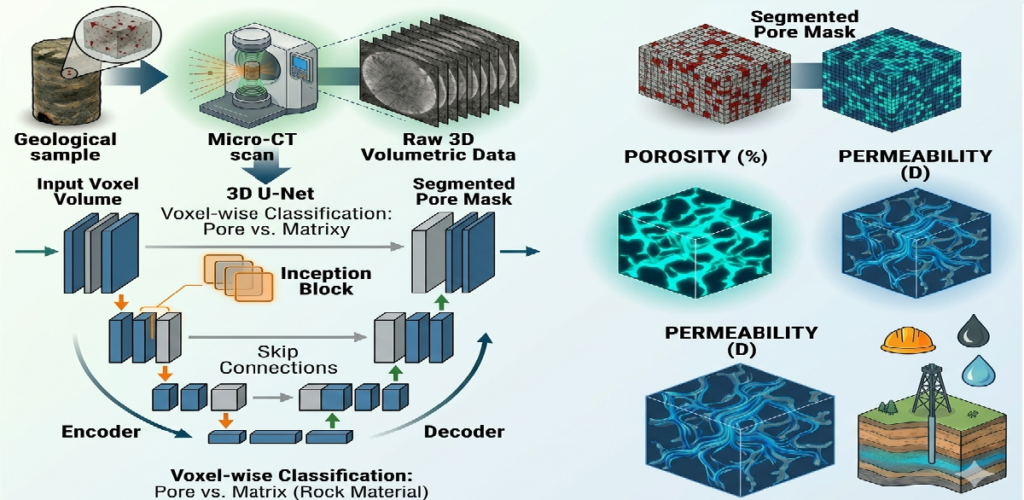
We developed a deep learning solution for segmenting and analyzing pore spaces within rock samples for the petroleum industry. Using 3D imaging techniques, the system quantifies porosity and permeability critical parameters for evaluating oil and gas reservoirs enabling faster, more consistent analysis of complex rock structures.
What We Built
A comprehensive computational geoscience pipeline using:
3D imaging processing for volumetric rock sample analysis
Deep learning segmentation models for pore space identification
U-Net architecture with 3D inception blocks for volumetric segmentation
Data augmentation techniques for improved model generalization
Cloud-based infrastructure for GPU-accelerated processing
The system acts as an automated geological analysis engine, dynamically segmenting pore spaces and quantifying reservoir properties from 3D imaging data.
Key Features
3D Image Segmentation
Deep learning-based pore space identification
Volumetric analysis of rock samples
High accuracy in complex pore structures
Rock Flow Properties
Automated calculation of porosity percentages
Permeability estimation from pore structure
Critical parameters for reservoir evaluation
Generalization Across Rock Types
Training on diverse rock samples
Adaptive processing for different lithologies
Robust performance across varying microstructures
Scalable Processing
GPU-accelerated segmentation
Cloud infrastructure for large datasets
Efficient handling of 3D volumetric data
How It Works
3D imaging data of rock samples is ingested
Data is preprocessed and normalized for model input
Deep learning segmentation model identifies pore spaces
Results are compiled for reservoir evaluation and decision-making
Results
Automated
pore space segmentation with high accuracy
Consistent
analysis across diverse rock types
Reduced
time for geological characterization
Improved
reservoir evaluation and resource extraction planning
Value Dilevered
This project transformed manual geological analysis into an automated, AI-powered process. By applying deep learning to 3D rock imaging, the solution enables faster, more consistent characterization of pore structures supporting improved decision-making in petroleum exploration and production, optimizing drilling techniques, and enhancing reservoir management efficiency.